
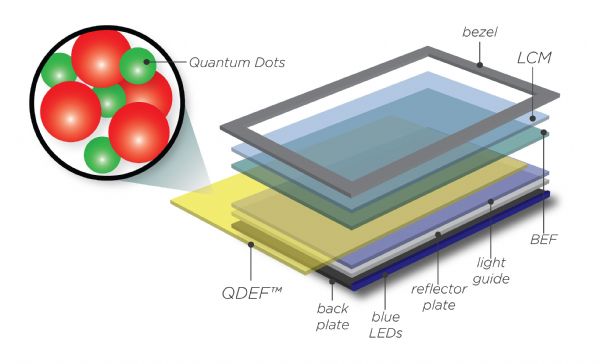
Quantum Dot
Quantum Dots (QDs) are both photoactive and electroluminescent, leading this technology to be at the forefront of future displays. Currently, mass production QD display modules incorporate the photoactive properties of the molecules in Quantum Dot Enhancement Film (QDEF), Quantum Dot Color Filters (QDCF), or Quantum Dot Color Converters (QDCC) with layers for a passive role (transforming a light source) in the display which we will be exploring in this article. R&D is already underway to incorporate QDs, “true” Quantum Dot LED (QLED) into the active role (emitting light) in a display similar to an AMOLED technology. Just like an OLED, the individual pixels will be comprised of Quantum Dots (emitting light) and will be actively controlled by applying electricity to each pixel.
QD technology is currently based off the standard TFT module of using liquid crystals to modulate the light through individual pixels. The differences begins with the backlight between the two options. TFTs historically use a white backlight to illuminate the pixels while a QD display utilizes a blue backlight. Using the blue backlight eliminates the need for a Blue color filter which increases the light output of the blue pixels. The standard color filters on a TFT eliminate 2/3s of the light passing through them allowing only one of the red, green, or blue light waves through. With QDs there is no color filter on any of the individual pixels. The blue light is allowed through in the blue pixels and the QD refracts the blue light passing through into Red and Green based on the size of the QD molecule in the pixels. Red QDs have a diameter of ≈50 atoms and green QDs have a diameter of ≈30 atoms. QDs emit different light based upon the size of the molecule as defined by the quantum confinement effect and directly related to their energy levels. The QD can be tuned in size to produce exact light waves resulting in vivid color hues and gamut for the display module.
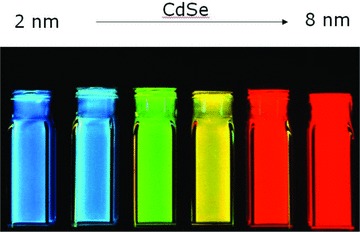
QDs have to be placed before or after the TFT polarizer due to this refraction property. The polarization of the light would be removed after passing through the QD and the light would not be blocked by the outer polarizer. When the QDs are placed above the polarizer in the display stack, the viewing angles for the display are not affected by the polarizer as they would be in a standard TN TFT which allows for wider viewing angles and better contrast ratios.
Research shows QDs will have purer colors, longer lifetime, lower manufacturing costs, and lower power consumption than most displays in the market today. Because QDs can be deposited on any substrate, the QD display market will soon include printable, flexible, and rollable QD displays.
Please Contact out to our team about incorporating QDs into a design/project and let us know if you have any questions or comments.
Leave a Reply